
What About Artistic Expression
Interview with Wato Tsereteli
by Koka Vashakidze / 2012
From October 19 to November 20, 2012 Tbilisi welcomed experimental art schools to take part in the first triennial – Offside Effect – dedicated to the educational issues. The author and co-curator of the project Wato Tsereteli talks to Caucasus ArtMag about the idea
Koka Vashakidze: Let’s look back to the starting point – what was the necessity of holding the triennial dedicated to the educational issues?
Wato Tsereteli: Once I arranged the meeting almost for all organizations, institutions, galleries and freelance curators actively involved in Tbilisi art scene, to discuss what could be the identification of Tbilisi on the global art map. Perhaps because of different views on the subject, our gathering turned into an absolutely unproductive chat. Further discussions with CCA-Tbilisi team about educational system’s transformation from medieval master-pupil configuration, dominantly to achromatic and problematic Bologna Regulations, draw me to an idea that despite of the importance of the educational issues, there is no permanent event dedicated to the education, in particular art education. I got in contact with Henk Slager - the curator of Georgian Pavilion at Venice biennale, because his recent years working practice mostly was linked to the educational issues after Bologna's process, about its adoption, assimilation and giving right direction in the context of reality. I knew he was the right person who could estimate the idea in a professional way and would be a great partner in project planning. My initiative excited Hank from the beginning. He agreed, it could truly be an important issue throughout the world and make Tbilisi a unique place. This attitude proved the significance and adequacy of the planned project to me once again.
K. V.: Didn’t you see any complicated aspects in realization on the start?
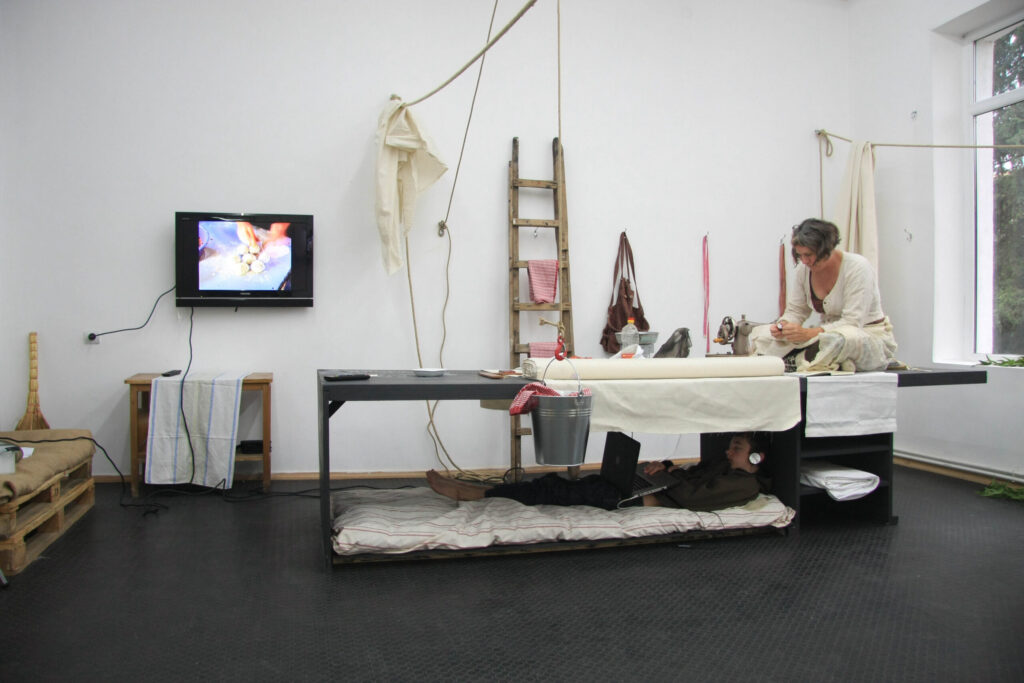
W. T.: Most difficult and interesting point of the topic was how to transmit methodology, economics, politics and strategies of education into the space. Everything is obvious when the matter refers to text - it can be written - but what about visual side of the same topic? What about artistic expression... Each school had to represent its own unique view in the space. The ability to react smarter on the existing reality, makes it possible to implement experimental courses much easier, than in academics where you’ll need a lot of time to go through bureaucratic steps or you won’t manage it at all.
K. V.: Has the time of assuming the outcomes of the triennial already come? Is the initial goal achieved?
W. T.: I think it’s too early to talk about the outcomes, because the process is not finished yet, it’s still going on. Just now, we plan to print a little text book in Netherlands, which will be the very important international publication; after we want to edit a big catalogue of “Offside Effect”. I’m sure when the publications emerge all of us will estimate this project from different angels. Triennial was invited at the 1st World Biennial Forum in South Korea as the key study of alternative biennials or triennials from the difficult countries. There were eighty representatives from different places on the meeting and Tbilisi was one of them. Besides, there was a talk about founding the association and our triennial will naturally become the member of it. This way, Tbilisi will be fixed on the international level one more time.